Knee Brace for Arthritis: Compression Sleeve or Unloader Brace?
A soft sleeve and a rigid OA brace may both be sold as a knee brace for arthritis. They are not interchangeable. One mainly provides compression and a feeling of support. The other is designed to change how load passes through a particular part of the knee.
Rather than asking which looks stronger, ask what the person needs it to do. For a distributor, that distinction belongs in the product description, not just in a conversation after a return.
Compression and unloading are different jobs
A compression knee sleeve uses flexible material around the knee. Some supports pull on; others wrap around and fasten. Pads or flexible stays may be included. A clinician may identify a role for compression or general support, but an ordinary sleeve should not be described as selectively unloading the inner or outer knee compartment.
An unloader knee brace uses a frame, straps and adjustments to redirect some load away from an affected compartment. DonJoy's OA range describes unloading for either the medial or lateral compartment. The intended side and direction are fitting requirements, not interchangeable settings. [2]
A hinge alone does not establish unloading. It may provide stability or limit bending without an OA-specific unloading action. If the specification only says “adjustable hinge,” ask what is being adjusted.
The practical trade-off is handling. A flexible support may fit under clothing but be difficult to pull on; a frame adds bulk and strap adjustments. Neither format promises a cure or cartilage regrowth. Check the sample against the intended use, not its appearance alone.
Pain severity is not a sizing chart
“Mild pain means sleeve; severe pain means rigid brace” is a poor buying rule. With confirmed osteoarthritis, a clinician may consider unloading when the affected compartment and overall assessment support it. Pain on the inside of the knee alone is not enough to choose a medial-compartment brace.
Previous ligament injury, instability, alignment and symptoms around the kneecap can change the decision. Discuss fitting with a qualified clinician or orthotist rather than choosing a stronger strap setting at home. A catalogue should distinguish compression, stabilising, postoperative and unloading products.
A useful study, with an important limit
The PROP OA trial in BMJ, published on 26 January 2026, included 466 adults aged 45 or older with knee OA symptoms. It compared advice, written information and exercise instruction with the same care plus compartment-specific bracing and support to encourage brace use.
At six months, the adjusted KOOS-5 difference was 3.39 points on a 0–100 scale (95% confidence interval 0.96–5.82). The authors described small improvements. Fitting, follow-up and adherence support were part of the intervention.
This was not a sleeve-versus-unloader trial, and it did not validate Huakang products. Published more than six months before this article, it is dated clinical background, not proof of recent search growth. It supports a fitting-and-care discussion, not a universal product recommendation. [1]
When it slides down, check fit before adding tension
A sample can look convincing on a table and still be awkward to use. Evaluate putting it on, fastening it, sitting, standing and removing it, within the product instructions and clinical advice.
Numbness, colour changes, severe irritation or worsening pain are not normal break-in signs. Seek prompt clinical advice rather than tightening or continuing to test the brace; urgent symptoms need urgent assessment. Follow the model-specific instructions. [4]
Two catalogue examples, without invented specifications
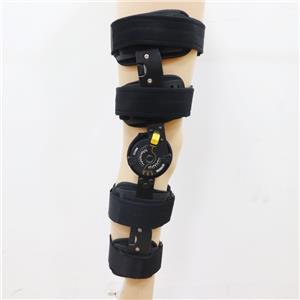
Huakang lists the KN004-C soft knee support and KN025-C dual OA brace. KN004-C is an open-style neoprene support, not a seamless knitted sleeve. These illustrate product formats, not a recommendation for an individual.
 KN004-C: official product photograph of the soft support.
 KN025-C: official product photograph. Appearance does not establish unloading force or clinical effectiveness.
Details below come from the supplier's pages, checked on 30 October 2026. They are published information, not independently measured specifications. [5]
A certification label on a sales page does not replace checking the document, its scope and the exact product supplied. Equally, an empty weight or size-range field is a question for the supplier, not an invitation to copy a competitor's number.
Carry both formats for different needs
A distributor can offer both without calling one an upgrade. Keep compression and unloading listings separate. Provide a model-specific measurement guide and a route for fitting questions.
When reviewing an OA knee brace supplier, request the sample and instructions together. Agree how replacement pads, straps, size exchanges and complaints will be handled. Track fit-related returns by model and size rather than promising a fixed reduction in returns.
Comparing sample options? Request model sheets and samples with the product format, destination, size mix and private-label requirements. Confirm the unloading configuration with the supplier and the clinical fitting requirements with the responsible professional.
Sources and scope
[1] “Provision of knee bracing for knee osteoarthritis (PROP OA).” BMJ, 26 January 2026;392:e086005. PubMed PMID 41587822.
[2] DonJoy / Enovis, “Osteoarthritis”; [3] Bauerfeind USA, “GenuTrain A3 – Arthritis Knee Brace.” Official product information accessed 30 October 2026; publication dates not stated. Brand descriptions are not independent clinical evidence.
[4] Dorset County Hospital, “Advice for Patients with a Knee ROM Brace,” approved September 2020, review date September 2023. Older ROM-specific guidance cited for warning signs only, not OA settings.
[5] Huakang Ortho, “Neoprene Knee Sleeves OPEN Without Hinges” and “ROM Dual OA Knee Brace with CE and FDA,” product pages accessed 30 October 2026.
Product education, not a diagnosis or individual treatment plan. Selection, unloading direction, wearing time and adjustments require professional assessment and the product instructions.