China Waist Support Suppliers: How to Ensure OEM Quality Control
China Waist Support Suppliers: How to Ensure OEM Quality Control
Waist supports and orthopedic back braces are among the highest-volume products in global orthopedic, rehabilitation, and occupational health markets. From clinical post-operative stabilization and chronic lumbar strain management to industrial lifting protection, demand for reliable spinal support continues to expand. To meet market volume and maintain competitive pricing, global orthopedic brands, medical device distributors, and healthcare private-label buyers frequently partner with China waist support suppliers for scalable OEM and ODM manufacturing.
However, for international buyers, sourcing waist support made in China is not merely about finding competitive unit pricing—it is fundamentally about ensuring consistent OEM quality control. A single structural defect, such as a failed seam under tension, premature hook-and-loop fatigue, or a deformed lumbar stay, can compromise clinical efficacy, trigger patient complaints, and damage hard-earned brand reputation. Understanding how a professional Chinese manufacturer implements quality control across raw materials, production processes, and finished-goods testing is essential when vetting long-term manufacturing partners.
Common Quality Risks in Bulk Sourcing of Orthopedic Waist Braces
When evaluating an ortho back brace for medical distribution or retail, international buyers often face specific quality vulnerabilities that commonly arise in non-standardized factories:
· Elastic Fatigue and Compression Loss: Inferior elastic webbing loses tension and tensile recovery after repeated stretching and washing cycles, leading to inadequate intra-abdominal pressure and weak lumbar support over time.
· Fastener Degradation (Hook-and-Loop Failure): Low-grade hook-and-loop fasteners experience rapid fiber peeling, fraying, and shear strength reduction after relatively few open-close cycles, causing the brace to loosen during daily movement.
· Lumbar Stay Deformation and Puncture: Support stays made of substandard plastics can crack under bending stress, while improperly capped metal/spring stays can wear through pocket seams and cause skin irritation or injury.
· Stitching and Seam Failure Under High Tension: Waist braces are subjected to significant lateral and circumferential tension during fastening. Single-line stitching or improper thread selection can lead to seam rupture at critical pull-strap junctions.
· Skin Irritation and Poor Breathability: Non-breathable synthetic fabrics trap heat and moisture, causing skin maceration and dermatitis, directly reducing patient wearing compliance.
Key OEM Quality Control Stages in Factory Production
A reliable medical brace manufacturer implements a comprehensive, stage-by-stage Quality Assurance (QA) system rather than relying solely on post-production visual checks.
1. Incoming Quality Control (IQC): Raw Material Verification
· Medical-Grade Elastic Webbing: Testing elastic recovery rate, elongation percentage, and tensile strength to ensure consistent compression across production batches.
· High-Cycle Fasteners: Sourcing high-density micro-injection hooks and durable loop fabrics tested for over 5,000+ open-close peel and shear cycles without performance degradation.
· Rigid and Flexible Stays: Verifying resilience, elasticity, and edge smoothing on PP/PE polymer stays, memory alloy plates, and high-tensile steel spring stays.
· Hypoallergenic & Breathable Fabrics: Inspecting high-elastic fish-ribbon mesh, spacer mesh, and perforated neoprene for skin compatibility, moisture-wicking properties, and REACH/OEKO-TEX compliance.
2. In-Process Quality Control (IPQC): Precision Assembly & Reinforcement
· Reinforced Structural Stitching: Employing automated CNC pattern stitching, double-needle seams, and reinforced Box-X stitching at high-stress strap anchors and D-ring attachments.
· Stay Pocket Encapsulation: Reinforcing stay casing ends with heavy-duty bartack stitching and abrasion-resistant binding to prevent stay migration or fabric puncture.
· Dimensional & Sizing Consistency: Conducting regular dimensional audits across complete size runs (S, M, L, XL, XXL, and plus sizes) against standardized master size templates.
3. Final Quality Control (FQC) & Functional Testing: Performance Validation
· Tensile & Pull-Out Load Testing: Simulating real-world lateral pulling forces using mechanical tensile testers to confirm that side pull-straps and closures withstand required peak tension.
· Static & Dynamic Compression Checks: Verifying anatomical contouring and uniform lumbar compression distribution on standardized torso mannequins.
· Packaging & Label Verification: Checking private-label accuracy, UDI barcodes, washing instruction labels, CE/FDA marks, and packaging seal integrity prior to palletizing.
What Overseas Buyers Should Look for in a China Waist Support Supplier
For orthopedic brands and medical device distributors, vetting a potential manufacturing partner requires looking beyond initial product catalogs and price lists. Key evaluation criteria include:
· Medical Manufacturing Certifications: Verify whether the facility operates under an ISO 13485 certified medical quality management system, alongside FDA establishment registration and CE MDR compliance.
· In-House Testing Capability: Inquire about the factory's internal testing lab—specifically whether they possess automated tensile testing machines, colorfastness testers, and fastener endurance equipment.
· OEM/ODM Engineering Flexibility: Assess the supplier's capability to modify structural elements, such as integrating pulley compression systems, customizable bionic lumbar pads, removable splints, or thermal gel pack pockets.
· Sample-to-Mass-Production Fidelity: Ensure the supplier works from formalized pre-production "Golden Samples" with detailed Technical Data Sheets (TDS) and defined tolerance ranges to prevent batch drift.
· Private-Label & Packaging Services: Confirm comprehensive branding options including high-frequency silicone logos, woven labels, customized color boxes, multilingual IFUs (Instructions for Use), and retail barcode labeling.
Explore Huakang's Waist Support & Ortho Back Brace Solutions
Xiamen Huakang Orthopedic is a specialized Chinese manufacturer of orthopedic braces and rehabilitation supports, delivering high-standard OEM/ODM manufacturing solutions to healthcare brands and distributors worldwide.
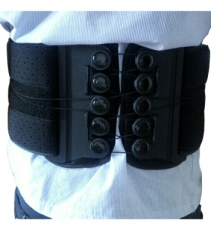
Our lumbar and waist support product line encompasses clinical-grade rigid spinal orthoses, low-profile breathable mesh back braces, double-pull compression belts, and innovative mechanical pulley-system waist supports. Every model is engineered with anatomical lumbar contouring, high-tensile reinforced stitching, and medical-grade breathable composites designed for maximum patient compliance and therapeutic stabilization.
With ISO 13485-certified facilities, strict multi-stage quality control protocols, and full in-house testing capabilities, Huakang ensures that every production batch meets rigorous international durability and safety benchmarks, bridging competitive Chinese manufacturing with uncompromising Western medical standards.
Looking for a Reliable China Waist Support Manufacturer?
If you are an orthopedic brand owner, medical device distributor, or rehabilitation product supplier looking to establish a reliable, high-quality OEM/ODM supply chain in China, Xiamen Huakang Orthopedic is ready to partner with you.
Contact our technical sales team today to discuss product specifications, request custom pre-production samples, review material test reports, or explore private-label packaging configurations.
Explore our Waist Support / Ortho Back Brace collection for detailed technical specifications and catalog downloads.
Disclaimer: This article is for general product and industry information only. It does not replace professional medical advice. Product selection, fitting, and use should follow the guidance of a qualified healthcare professional.